
Pool Decks · Fort Lauderdale
A pool deck is the only surface we coat where the customer is barefoot, wet, and in a hurry. That single fact rules out about half the products on the market before anything else is considered. The finish has to grip when it is streaming with water, it has to stay cool enough to cross at three in the afternoon in July, and it has to hold its color under direct sun and chlorinated splash. Getting one of those right and missing another is the most common way a good-looking deck becomes an unusable one.
Texture Has to Be In the Coating, Not On It
There are two ways to make a deck grip. One works and one is a shortcut people keep buying.
The shortcut is broadcasting grit over a finished surface and sealing it down, or worse, sprinkling it into a wet topcoat and hoping it stays. The problem is that the grit sits proud of the film, which means it takes all the abrasion. In the traffic lanes, the path from the door to the steps, from the steps to the chairs, it wears off first. Within a couple of seasons you have a deck that grips at the edges and is slick exactly where everybody walks, which is worse than no texture at all because people have stopped being careful on it.
The approach that lasts is dosing texture into the topcoat itself so the aggregate is suspended through the film rather than sitting on top of it. As the surface wears, more aggregate is exposed rather than less. The grip you have in year four is the grip you had on day one.
The dose is a judgment call and it is worth getting specific about. Too little and the deck passes a dry test and fails a wet one. Too much and it feels like sandpaper underfoot and holds every bit of sunscreen and leaf litter that lands on it. The only honest verification is a wet walk before the job is called finished, which is what we do on every deck we coat in Fort Lauderdale.
Surface Heat Is a Color Decision
How hot a deck gets underfoot is driven mostly by how much light the finish reflects. That makes color a functional specification rather than a style preference, which is a conversation some clients do not expect to have.
A charcoal or deep bronze deck looks superb in a photograph and is genuinely unusable on an August afternoon. People hop to the nearest towel or shade and stop using the space during exactly the hours it exists for. A light tan, pearl or pale gray finish stays crossable through the worst of the day.
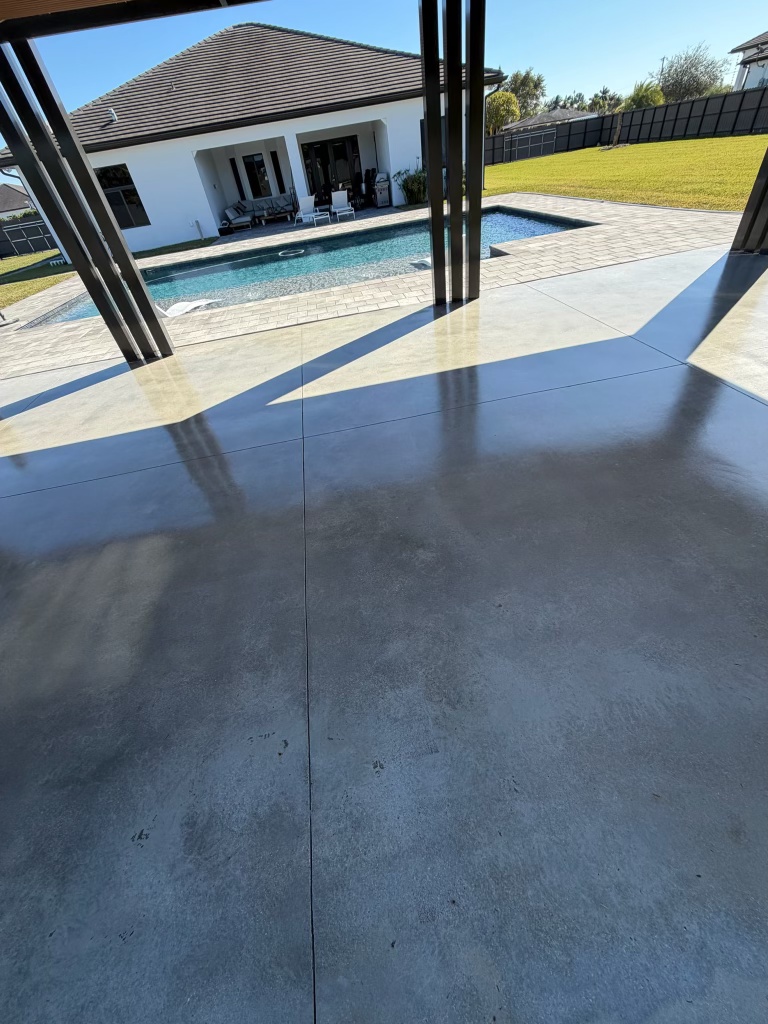
Shade changes the math. Under a screened lanai or a solid cover you can carry a darker tone without the heat penalty, because the deck is never taking direct sun. An open deck on the south or west side of the house has no such allowance. We will tell you plainly if a color you have picked is going to be a problem in July, because a surface nobody can walk on has failed no matter how it photographs.
Glare is the quieter half of this. A high-gloss finish next to a pool throws reflected light back at everyone sitting around it, which is why we usually pull the sheen down on an open deck even when the client came in asking for shine.
UV Is What Decides the Topcoat
Standard epoxy ambers under ultraviolet light. It is a real chemical change in the resin, not dirt, and it cannot be cleaned off or polished out. On a light-colored deck it is extremely visible: a pearl or pale tan surface shifts warm and yellow across a season, and it does it unevenly because the shaded parts of the deck stay closer to their original color.
That is why any surface of ours taking direct sun gets a UV-stable topcoat, typically an aliphatic urethane or a polyaspartic, rather than a clear epoxy sealer. The cost difference is real and it is small next to redoing a deck that has gone yellow in patches.
This is a useful question when comparing quotes. If a proposal for an open pool deck does not name the topcoat chemistry, that is a gap worth asking about directly, because it is a place where a quote gets cheaper without looking cheaper.
Chlorine and salt work on the same layer. Splash-out lands in a band around the coping and sits there, so that band takes more chemical exposure than any other part of the deck. It needs the same build as everything else, and it is a common place for a thin quote to save material.
Scheduling Around the Afternoon Storm
From roughly June through September the sky opens up in the afternoon with very little warning, and a coating that has not reached the point where rain no longer matters can be ruined in ten minutes.
Water landing on an uncured film does several things, none good. It leaves craters and dimples in the surface, it can drive a haze into the resin, and on a topcoat that has just been rolled it interrupts the film so the finish cures with a visible boundary. There is no repair that blends. The affected area comes off and goes back down.

So outdoor deck work here gets scheduled to the forecast, not to the calendar. Coats go down in the morning, which buys the longest possible dry window before the afternoon builds. Fast-cure systems shorten the exposure and that is a large part of why we lean on them for exterior work. And sometimes the right call is that today is not the day, which is a conversation we would rather have at eight in the morning than at four in the afternoon standing over a ruined topcoat.
Humidity stretches everything as well. Cure times here run longer than a datasheet written for a dry climate suggests, so we build weather into the schedule rather than promising a date we would have to walk back.
Questions Deck Owners Ask Before Booking
Will the deck stay cool enough to walk on?
If the color is chosen for it, yes. Surface temperature tracks how much light the finish reflects, so a light tan or pearl deck stays usable through the afternoon while a charcoal one genuinely does not. Under a screen or a solid cover you have more freedom, because the deck never takes direct sun.
How is the grip after a few years of use?
That depends entirely on whether the texture was dosed into the topcoat or scattered over it. Aggregate suspended in the film keeps being exposed as the surface wears. Grit sitting on top wears off first in the traffic lanes, which is where you least want to lose it.
What happens if it rains during the install?
On a cured surface, nothing. On a film that has not yet reached the stage where water no longer matters, rain leaves craters and haze that cannot be blended out, so the area comes off and goes back down. We schedule coats for the morning and to the forecast, and we will postpone rather than gamble.
FAQ
Pool Deck Finish Questions
Will the deck stay cool enough to walk on?
If the color is chosen for it, yes. Surface temperature tracks how much light the finish reflects, so a light tan or pearl deck stays usable through the afternoon while a charcoal one genuinely does not. Under a screen or a solid cover you have more freedom, because the deck never takes direct sun.
How is the grip after a few years of use?
That depends entirely on whether the texture was dosed into the topcoat or scattered over it. Aggregate suspended in the film keeps being exposed as the surface wears. Grit sitting on top wears off first in the traffic lanes, which is where you least want to lose it.
What happens if it rains during the install?
On a cured surface, nothing. On a film that has not yet reached the stage where water no longer matters, rain leaves craters and haze that cannot be blended out, so the area comes off and goes back down. We schedule coats for the morning and to the forecast, and we will postpone rather than gamble.
Walk Your Deck With Us
Send photos of the deck including a close shot of the coping. We will talk through color, texture dose and topcoat chemistry, then put a fixed number in writing. English and Español.
Get a Fixed Written Quote →Pool deck coatings in Fort Lauderdale · Gallery · (305) 409-9022