
Fort Lauderdale · Broward County
Commercial floors installed around your trading hours
A floor that closes your business for a week costs more than the floor. We schedule commercial work overnight and across weekends so the doors open on time.
What we coat commercially in Fort Lauderdale
Different rooms have different rules, and in a few of them the rules are written by an inspector.
Restaurant kitchens and bars
Las Olas and Himmarshee run dense with kitchens. These need a coved, seamless, slip-rated system that satisfies a health inspector and survives hot oil, constant washdown and dropped glass.
Warehouses and distribution off Cypress Creek
Forklift traffic, pallet drag and point loading. The specification here is about thickness and joint treatment rather than appearance, and the joints are where these floors actually fail.
Retail and showroom floors
Storefronts where the floor is part of the sell. Durable enough for daily traffic, presentable enough for the brand, and installed overnight so the shop is not dark on a Saturday.
Medical, dental and veterinary
Rooms that get disinfected constantly. Seamless surfaces with no grout line for anything to live in, and chemical resistance rated for what actually gets used on them.
How commercial work differs from residential
Downtime is the real cost
A kitchen closed for five days can lose more than the floor costs. Everything about how we schedule commercial work follows from that.
Joints move
A large slab expands and contracts. Coating straight over a control joint means a crack telegraphs through within a season. Joints get treated as joints.
Specification is not optional
Kitchens need cove and slip ratings. Warehouses need mil thickness that matches the load. These are requirements, not upgrades, and a quote that skips them is not cheaper.
The slab is usually older
Commercial concrete in Broward is frequently decades old with previous coatings, saw cuts and repairs. Prep takes longer and it drives the timeline more than the coating does.
Working around a business that has to stay open
Most of the commercial floors we install in Fort Lauderdale go down between close and open. A restaurant finishes service, the crew comes in at eleven, and the room is ready before the first delivery. A warehouse gives us a Saturday. A retail unit gives us two nights in a row. That constraint shapes the whole job.
It changes the products. Fast-cure polyaspartic systems can take foot traffic in hours rather than days, which is what makes an overnight turnaround possible at all. They cost more per square foot than a standard epoxy, and for a business that cannot close, the difference is usually smaller than one day of lost trade.
It also changes the sequencing. We phase larger spaces so half the floor is always usable, which means planning break lines somewhere sensible rather than wherever the shift ended. In a kitchen that usually means splitting at the line, doing the cook side one night and the dish side the next.
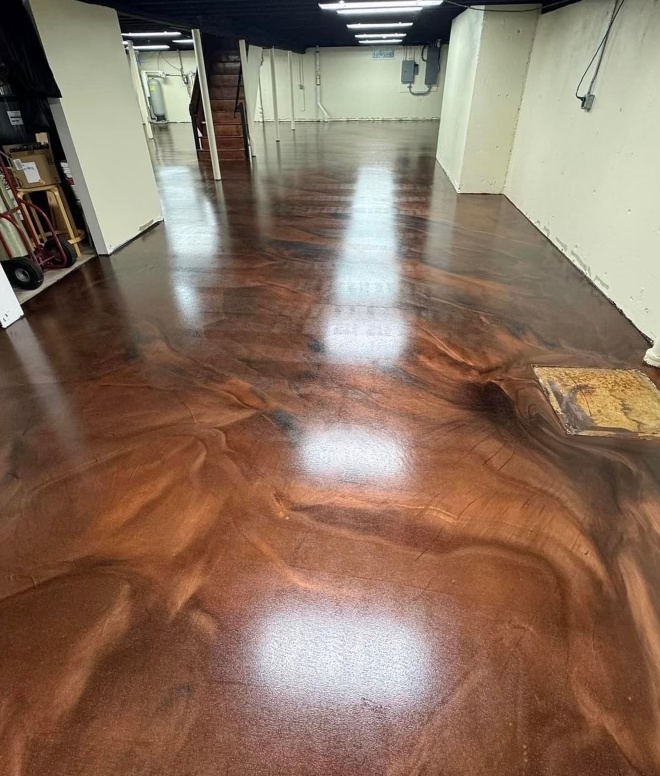
Worth knowing about older Broward commercial slabs: many of them have been coated before, sometimes more than once, and what is under your current floor drives the schedule more than the new system does. We core or grind a test patch before quoting a large space, because finding a second failed coating halfway through a Saturday night is how a job overruns into Monday trading.
The other scheduling reality is the loading dock and the deliveries. A warehouse floor cannot be coated while pallets are moving over it, and the cure window is not negotiable. We plan around your delivery schedule rather than assuming a weekend is clear, and we would rather phase a job over three weekends than close a distribution floor for one.
The specification depends on the room and it is worth being specific. A commercial kitchen needs a coved base so there is no ninety-degree corner between floor and wall for grease and water to collect in, a seamless surface with no grout, and a texture that grips with oil and water on it. That last part gets argued about, because a properly slip-rated kitchen floor is harder to mop. It is still the right call, and a health inspector agrees.
A warehouse is a different problem. The question there is load: what runs on it, how heavy, and on what wheels. Steel-wheeled pallet jacks are far harder on a floor than pneumatic forklift tires, and point loading from racking legs concentrates stress in small areas. That drives thickness and it drives how we treat the joints, which is where warehouse floors actually break down.
Medical and veterinary rooms sit somewhere else again. There the requirement is that nothing can harbor anything: seamless, coved, and chemically resistant to whatever disinfectant is used daily. We ask what they clean with before quoting, because a floor rated for the wrong chemistry breaks down quietly and nobody notices until it is soft.
Across all of it we quote a fixed written number before starting, itemized so prep and finish are separate lines. If the slab needs repair before a coating makes sense, that shows up as its own line rather than being buried, and if the honest answer is that your floor needs replacing rather than coating, you will hear that too.
Commercial flooring questions from Fort Lauderdale
How long do we have to close?
Usually not at all. Most of our commercial work happens overnight or across a weekend using fast-cure systems that take foot traffic in hours. A single-room job is often one night. A large space gets phased so part of the floor stays usable throughout. Tell us your hours first and we will build the schedule around them rather than the other way round.
Will it pass a health inspection?
A properly specified kitchen floor will, and that means coved base, seamless surface, and a slip rating appropriate to a wet greasy environment. Those are the parts a cheap quote leaves out. If you have had a specific comment from an inspector, tell us what it said and we will spec directly against it.
Our warehouse floor is cracked and patched. Is coating it a waste of money?
Depends what the cracks are doing. Static cracks get filled rigidly and disappear under the coating. Moving cracks, and anything that has been patched repeatedly, mean the slab itself is shifting, and no coating fixes that. We will tell you which you have. Sometimes the honest answer is that a section needs concrete work first, and that is better heard before you have paid for a floor.
Can you match our brand colors?
Generally yes for solid colors and flake blends, within the range the systems come in. Exact corporate color matching is possible but costs more and takes lead time, so tell us early if it matters. We can also inlay lines, walkways and safety markings directly into the floor rather than painting them on afterward, which lasts considerably longer.
What about the smell during install?
Modern systems are far lower odor than they used to be, but a fast-cure product still has one. In an occupied building we ventilate and schedule around it, which is another reason overnight suits this work. For medical spaces or anywhere with sensitive neighbors we will talk through low-odor options before booking.
Do you work with property managers and boards?
Regularly. We are used to producing insurance certificates, scheduling around building access, and dealing with a management company rather than the end user. If you need documentation for a board or a landlord, ask and it comes with the quote.
Related work in Fort Lauderdale
Commercial spaces often need more than one system. Front-of-house frequently takes a metallic floor while the back takes something purely functional, and a flake system is the usual answer where wear needs hiding. Deeper detail on the main commercial epoxy page. We work throughout Fort Lauderdale and Broward County, and completed commercial jobs are in the gallery.
Get a fixed written quote for your space
Tell us the square footage, what the room is used for, and the hours you cannot close. We will come and look, then put a fixed number in writing with the phasing spelled out.