
Concrete Polishing in Miami Beach
Mechanically polished concrete floors for Miami Beach hotel lobbies, retail showrooms, modern restaurants, and commercial interiors. Densified, sealed, and finished in matte, satin, or high-gloss, the lowest-lifecycle-cost commercial floor system available, built for the island’s hospitality and design demands.
Polished Concrete vs Coatings
Polished concrete isn’t a coating, there is nothing applied on top of the slab. We mechanically grind, hone, and polish the existing concrete to a controlled gloss, then chemically densify it with a lithium silicate hardener and seal it with a guard topcoat. The result is the existing slab itself, finished to a hard, smooth, chemically resistant, easy-to-clean surface.
Because there’s no coating layer, polished concrete cannot peel, delaminate, chip, or fail at the bond line, the way every applied coating eventually can. The lifecycle cost is significantly lower than epoxy or urethane systems, and the look is the modern minimalist aesthetic that defines current hospitality and retail design.
Built for Modern Miami Beach
Miami Beach’s design language has shifted toward modern minimalism, exposed concrete, clean lines, monochromatic palettes that let the architecture and the merchandise speak for themselves. Polished concrete is the foundational floor of that aesthetic. The hotels, restaurants, and retail spaces leading the design conversation on the island are increasingly choosing polished over carpeted, tiled, or coated alternatives.
343 Epoxy operates a full-spec concrete polishing system: planetary grinders, diamond-tooled progression from coarse metal-bond pads through resin-bond polishing, lithium silicate densifier, and sealant topcoat. We grind to the aggregate exposure level the design calls for, cream finish for the cleanest matte look, salt-and-pepper for subtle texture, or full aggregate for a terrazzo-style pattern.
Whether you are renovating a Lincoln Road retail flagship, opening a new restaurant in Sunset Harbour, or refreshing a hotel lobby in the Faena District, polished concrete is the floor that lasts longest, costs least over its lifecycle, and delivers the design-forward look the island’s properties are competing on.
Lowest Lifecycle Cost on the Island
No Coating to Fail
The slab itself is the finished surface. No bond line to delaminate, no topcoat to chip, no system to replace. The longest-lasting floor system we install, typically 25+ years before a refresh.
Hard & Stain-Resistant
Lithium silicate densifier hardens the concrete surface to ~9 on the Mohs scale, harder than most floor tile. Stain-resistant guard sealer locks out spills and aggressive cleaning chemicals.
Three Gloss Levels
Matte, satin, or high-gloss finish based on the design intent. Salt-and-pepper, cream, or full-aggregate exposure based on the look you want. We control the entire polishing progression to your spec.
5-Year Warranty
Every polished concrete installation is backed by a 5-year warranty on the densifier, sealer, and finish quality. Local crew, fast call-back response.
How We Polish Concrete Floors
Concrete polishing on Miami Beach typically takes three to five days depending on square footage, the gloss level, and the aggregate exposure spec.
Site Walk & Spec
We assess the existing slab, age, condition, hardness, aggregate distribution, crack pattern. Recommend the right finish level (cream, salt-and-pepper, full aggregate) and gloss target. Detailed scope with operational phasing.
Coarse Grind & Repair
Initial metal-bond diamond grind opens the surface and exposes aggregate to the spec’d level. Cracks routed and filled with semi-rigid joint filler. Surface left flat and ready for densification.
Densify & Hone
Lithium silicate densifier applied and worked into the surface. Resin-bond polishing pads progress through 100, 200, 400, 800 grits, each step refines the gloss and removes scratches from the previous one.
Final Polish & Guard
Final 1500 or 3000 grit pass for high-gloss finishes. Stain-resistant guard sealer applied to lock in the finish. Final inspection, walkthrough, warranty handoff. Floor ready for traffic immediately.
Polished Concrete Across Miami Beach
Polished concrete demand on the island is concentrated in commercial and hospitality applications where the modern minimalist aesthetic, the durability, and the lower lifecycle cost all align with the operator’s priorities.
Hotel Lobbies & Public Spaces
Miami Beach hotel design has shifted decisively toward modern minimalism, exposed materials, neutral palettes, architectural restraint. Polished concrete is the foundational floor of that aesthetic. We polish lobby spaces, restaurant entrances, hallway transitions, and amenity-floor common areas in boutique hotels along Collins Avenue, the Faena District properties, and the Mid-Beach hotel renovations underway across 23rd-63rd Streets. The system meets hospitality slip-resistance standards while delivering the design intent the property is built around.
Retail & Showroom Floors
From Lincoln Road’s flagship retail to the boutique showrooms in Sunset Harbour and the Design District spillover into Miami Beach, polished concrete is the floor that lets the merchandise be the focus. The neutral, reflective surface amplifies interior lighting, doesn’t compete with displays, and handles foot traffic, store fixtures, and inventory movement without showing wear. Many of our retail clients refresh the polish every 8-10 years to maintain the gloss, a fraction of the cost of replacing tile or hardwood.
Modern Restaurants & Cafes
The South Beach and Sunset Harbour restaurant scene increasingly opens with polished concrete in the dining room, kitchens (paired with urethane cement in the cook line), and customer-facing zones. The surface is easy to clean, slip-rated, doesn’t trap food debris in grout joints, and pairs visually with the exposed-material design language defining the island’s current restaurant aesthetic. We coordinate the install with the construction GC and FF&E delivery schedule.
Modern Office & Coworking Spaces
The Miami Beach office and coworking market, particularly along Lincoln Road and in the converted Art Deco buildings near Washington Avenue, has adopted polished concrete as the standard finish for executive offices, collaboration spaces, and coworking common areas. The same lifecycle-cost story applies: lower than tile, lower than carpet, lower than coated systems over a 20-year horizon.
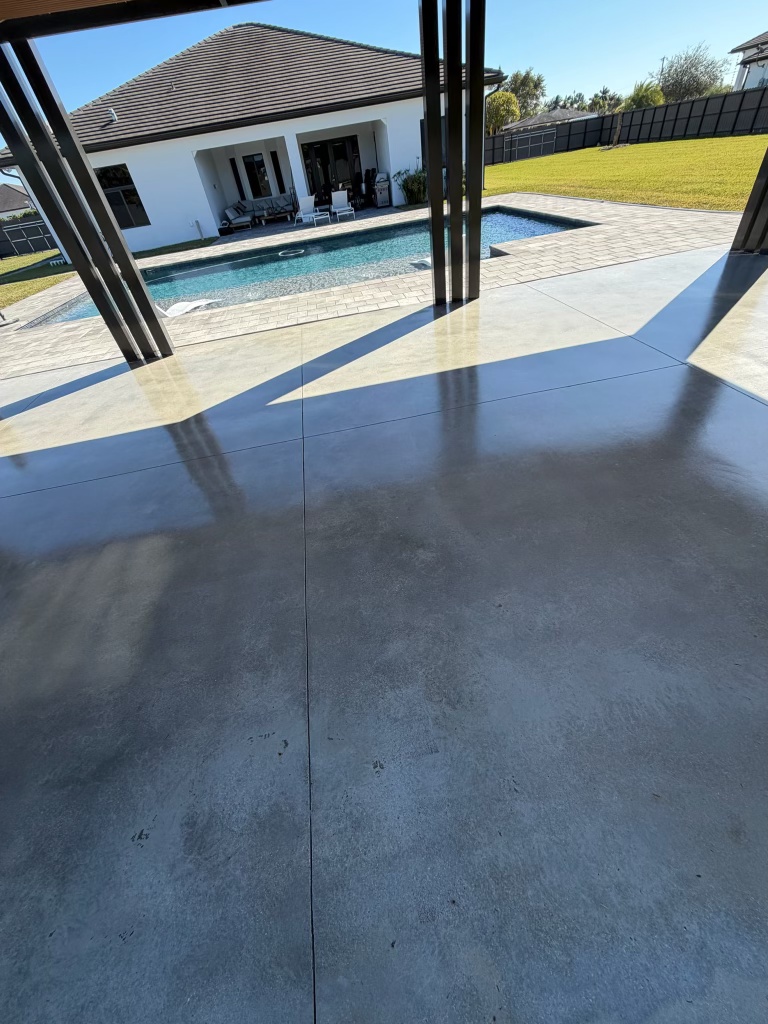
Polishing Finish Levels & Looks
Polished concrete delivers a wide range of looks within a single material system. The final aesthetic is controlled by three factors: how much aggregate is exposed during the initial grind, how high the polish is taken, and the color treatment applied between densification and final pass.
- Cream Finish (No Aggregate Exposure): The cleanest, most uniform look. The grinder removes only the surface laitance, no aggregate visible. Polished to a uniform matte, satin, or gloss depending on spec. The default for modern minimalist interiors.
- Salt-and-Pepper Finish (Light Aggregate): Initial grind exposes the smallest aggregate particles. Subtle texture and visual interest without becoming busy. Common for retail, restaurant, and hotel lobby applications.
- Full Aggregate Finish (Terrazzo Style): Aggressive initial grind exposes the larger stone aggregate distributed through the slab. Creates a terrazzo-style pattern from the existing concrete, no need for new terrazzo pour. Premium look, longest install time.
- Color-Hardened Polishing: Reactive color stains or color-hardener systems applied during the polishing progression to achieve custom warm tones, gray-scales, or specific designer colors. Common when matching an existing brand palette.
- Polished Overlay (For Damaged Slabs): When the existing slab is too damaged or too soft to polish directly, a self-leveling polishable overlay can be poured first. Adds 1-3 days to the install and roughly a fixed written quote/sqft to the cost, but produces a polish-quality finish on slabs that otherwise couldn’t be polished.
During the on-site walk, we test-grind a sample area in an inconspicuous corner so you can see the actual aggregate distribution and hardness in your slab before committing to a finish level. Some Miami Beach slabs polish beautifully; others have hardness or aggregate distribution problems that change the recommendation.
Polished Concrete Cost in Miami Beach
Polished concrete costs on Miami Beach is priced per square foot installed, and the number depends on the gloss target, aggregate exposure spec, slab condition, and project size. Standard cream-finish polishing on a sound commercial slab sits at the lower end. Full-aggregate exposure with high-gloss progression on a problem slab requiring overlay sits at the upper end. Color-hardened or designer-spec installations sit between.
The lifecycle-cost story is what drives most commercial polishing decisions on Miami Beach. A polished concrete floor lasts 25+ years before any refresh is needed, doesn’t require waxing or stripping, doesn’t have grout joints to maintain, and won’t peel or delaminate the way coated systems eventually do. Compared to tile (15-20 year life, grout maintenance, replacement during failure), carpet (5-7 year replacement cycle), or epoxy coatings (10-15 year life, full-system replacement at end of life), polished concrete consistently wins on 20-year total cost of ownership.
For larger commercial projects, full hotel renovations, retail flagships, restaurant openings, we provide value-engineered scope where a portion of the floor (back-of-house, storage, mechanical rooms) gets a basic densified-and-sealed finish while the customer-facing zones get the full progression. That kind of scope split keeps the budget controlled while preserving the design intent where it matters.
Miami Beach Polishing Questions
What designers, GCs, hotel ops, and restaurant operators ask before booking concrete polishing.
01Can you polish my existing slab, or do we need a new pour?
02How long does the install take?
03Is polished concrete slippery?
04How do we maintain it?
05Can you match a specific color or design reference?
06How does polished concrete compare to epoxy on lifecycle cost?
Ready for the
Modern Concrete Look?
Call 343 Epoxy for a free on-site walk-through anywhere on Miami Beach. We’ll test-grind a sample area so you see the actual finish before committing. See completed polishing projects across Miami-Dade.