
Fort Lauderdale · Broward County
Metallic floors, poured once and never repeated
A metallic floor is a chemical reaction you get one attempt at. There is no undo, no second pass, and no way to match it later. That is the appeal and it is also the risk.
Where metallic makes sense in this city
It is a showpiece finish. It belongs where people look at the floor, not where forklifts live.
Las Olas retail and restaurants
Storefronts and dining rooms where the floor is part of the design brief. A metallic pour reads as a custom surface rather than a coating, which is the point on a street where every neighbor has spent money on the interior.
Condo lobbies and amenity decks
High-rise common areas along the beach corridor where boards want something durable that does not look institutional. We work around building access rules and pour in sections when the lobby cannot close.
Showrooms and dealerships
Cypress Creek and Commercial Boulevard have a dense run of auto and marine showrooms. A reflective floor under a boat or a car does most of the lighting work for you.
Residential garages and interiors
Victoria Park and Rio Vista homeowners who want the garage to match the house. Also entryways, home gyms and the occasional interior room where a poured floor replaces tile entirely.
What makes a metallic pour succeed or fail
Slab prep
Metallic is self-levelling and thin. Every low spot, trowel mark and old adhesive ridge telegraphs straight through the finish. Grinding is most of this job.
Moisture
Fort Lauderdale slabs push vapor. A metallic pour over an untested slab develops blisters that cannot be repaired invisibly, because the pattern cannot be matched.
Temperature
The resin cures on its own clock and heat accelerates it. Pouring in an unconditioned Broward warehouse in August gives you minutes, not the working time the datasheet promises.
The installer
The pattern comes from how the resin is moved in the first fifteen minutes. That is technique and it cannot be bought. It is the one part of this trade where the crew genuinely decides the outcome.
How a metallic floor is actually made
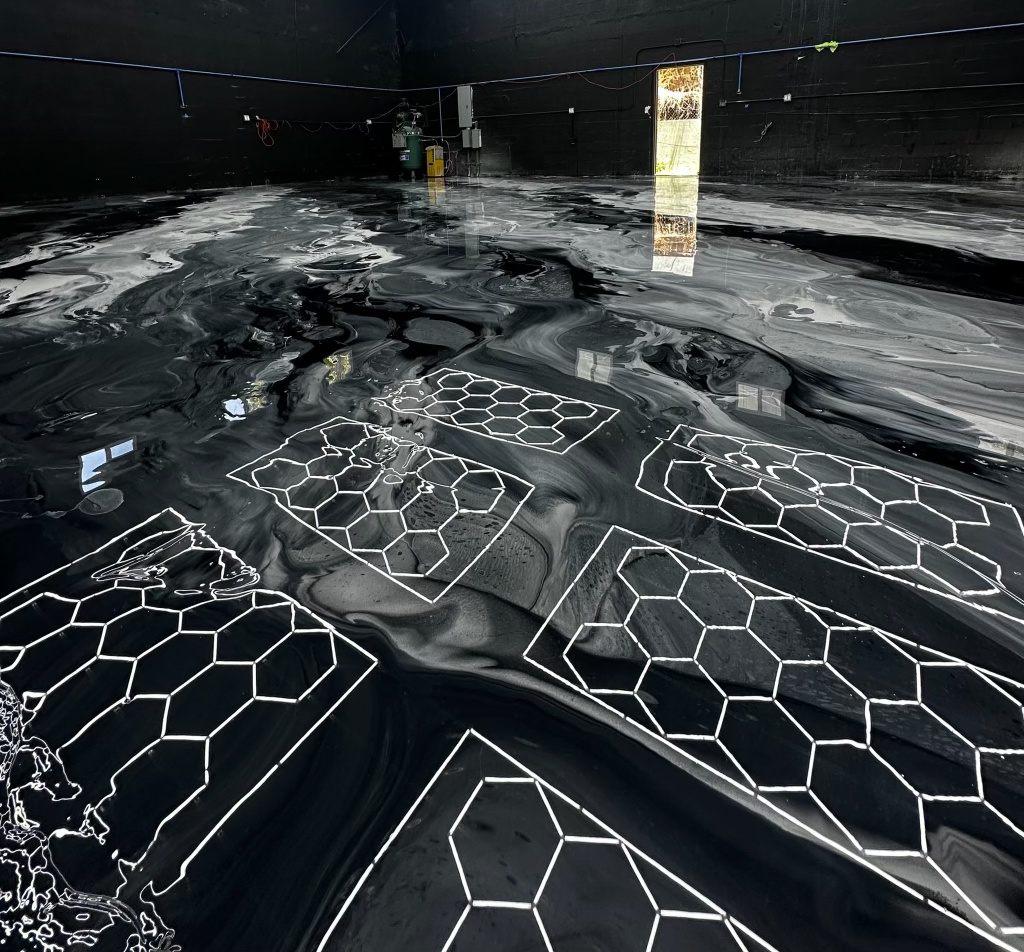
Metallic epoxy is a pigmented resin carrying fine metallic particles. Poured onto a primed slab, those particles migrate as the resin moves and settles, and where the film is deeper the color pools darker, where it thins it goes lighter. Drag a tool through it and the particles follow the current. What you get is the record of that movement, frozen when the resin gels.
That is why no two floors match and why nobody, including us, can promise you a specific pattern from a photograph. We can promise a palette, a level of contrast, and a general character. The exact veining is decided in the room on the day.
It also means there is no touch-up. A damaged section cannot be blended, because the surrounding pattern is unrepeatable. Repair means re-pouring the area and living with a visible boundary, or re-pouring the whole floor. Anyone who tells you a metallic floor can be spot-fixed has not had to do it.
One Fort Lauderdale-specific point worth making: a lot of the buildings we pour in are older concrete-block construction on grade, and the slabs were never sealed under. That is fine, but it makes the moisture reading the single most important number in the quote. We have walked away from metallic jobs on slabs that read too high and recommended a breathable system instead. That conversation is cheaper than a blistered floor nobody can repair.
The other is scheduling around the building rather than the calendar. Lobby and amenity pours in the beach-corridor towers have to fit around resident access, service elevators and quiet hours, so we often pour in sections overnight. Sectional pours need a planned break line, decided before the resin opens, because a cold joint in the middle of an open pattern reads as a mistake for the life of the floor.
Because of that, most of the work happens before any resin is opened. The slab gets diamond ground to a consistent profile, every crack and joint is dealt with, and the surface is read for moisture. Then it gets a primer coat, which is also the last chance to catch a low spot, since the metallic layer is too thin to correct level.
The pour itself is fast and it does not wait. Two people work the resin with squeegees and rollers, moving it into the pattern while it is still open, and a heat gun or torch pulls trapped air to the surface. In a Fort Lauderdale summer, in a space without air conditioning, the working window closes considerably faster than the datasheet suggests, so we schedule these for early morning or bring temporary cooling.
Then it cures overnight and takes two clear polyurethane topcoats. Those topcoats are what you actually walk on and what takes the abrasion, so the gloss level and the scratch resistance are decided there rather than in the metallic layer. On a floor that gets sun through glass, a UV-stable topcoat is not optional, because standard epoxy ambers noticeably and a light metallic will shift color within a year.
We pour metallic across Fort Lauderdale from our Miami-Dade shop, and the quote comes in writing with a fixed number before we start. If your slab needs work first, that gets itemized separately so you can see what is prep and what is finish.
Metallic epoxy questions from Fort Lauderdale
Can you match a floor I saw in a photo?
We can match the palette and the general character, not the pattern. The veining comes from how the resin moves in the first fifteen minutes and it is genuinely unrepeatable, including by the person who poured the original. Anyone promising you an exact match is either misunderstanding the product or telling you what you want to hear.
What happens if it gets damaged?
This is the real trade-off and you should hear it before you buy. A gouge cannot be blended in, because the surrounding pattern cannot be recreated. The options are re-pouring that section and accepting a visible edge, or re-pouring the room. For spaces where damage is likely, we will steer you toward flake instead, which repairs almost invisibly.
Is it slippery?
A gloss metallic with no additive is slick when wet, and in a restaurant or an entry off a pool deck that matters. We can add a fine texture to the topcoat, which costs a little clarity in the reflection but makes the floor safe. In a dry showroom we usually leave it smooth.
How long does the whole job take?
Typically three to four days for a normal space: grind and prep on day one, primer, the pour, then topcoats, with cure time between each. Light foot traffic usually the day after the final topcoat and full use in about a week. Humidity here stretches all of it, so we build weather into the schedule rather than promising a date and missing it.
Will it yellow in the sun?
Standard epoxy does amber under UV, which is very visible on a light metallic. Any floor of ours getting direct sun through glass gets a UV-stable polyurethane topcoat. If somebody quotes you a metallic floor for a sunroom without mentioning UV, that is a real gap in the quote.
Can you pour over tile?
Usually not directly, and we would rather tell you that up front. Tile has to come up or be ground back to a sound, level substrate, because any movement or hollow underneath telegraphs through a thin metallic layer within months. Removal is dust and disruption, and it is the difference between a floor that lasts and one that cracks along every grout line.
Related work in Fort Lauderdale
Metallic is one option among several. If the space takes real abuse a flake system hides wear far better, and for back-of-house areas a straight commercial coating is the sensible spend. The main metallic epoxy page has the full system detail. We cover all of Fort Lauderdale and Broward County, and poured floors we have finished are in the gallery.
Get a fixed written quote for a metallic floor
Tell us the room, the square footage and what it gets used for, and send a photo of the existing slab. We will tell you whether metallic is the right call or whether something else serves you better.