
Metallic Pours · Fort Lauderdale
Most floor systems give you a second chance. A flake floor can be re-broadcast and blended. A solid color can be recoated. A metallic pour cannot, because the thing you are buying is the record of how the resin moved during about fifteen minutes, and that movement is not repeatable by anybody, including the crew that did it the first time. That one property drives everything else about specifying a metallic floor in a condo lobby, a showroom, or a retail unit.
Why the Pour Cannot Be Rehearsed
Metallic epoxy is pigmented resin carrying fine metallic particles. Poured onto a primed slab, the particles migrate as the resin settles and moves. Where the film sits deeper the color pools darker; where it thins it goes lighter. Pull a tool through it and the particles follow the current. When the resin gels, that motion is frozen into the floor permanently.
Two people work it with squeegees and rollers while it is still open, and a torch or heat gun pulls trapped air to the surface. It is fast, it does not wait for anyone, and the outcome is decided by technique rather than by which bucket was bought. This is the one part of the trade where the crew genuinely determines the result.
The practical consequence is that nobody can promise you a specific pattern from a photograph. What can be promised is a palette, a level of contrast, and a general character. The exact veining is decided in the room on the day, and any contractor telling you otherwise is either misunderstanding the product or telling you what you want to hear.
The second consequence is more commercially important: there is no touch-up. A gouge cannot be blended in because the surrounding pattern cannot be recreated. The options are re-pouring that section and living with a visible boundary, or re-pouring the room. For a space where damage is likely we will steer you toward flake instead, and say so plainly rather than sell the more expensive floor.
Light Is Doing Half the Design Work
A metallic floor is a reflective surface, so what it looks like depends entirely on what is above it. That makes lighting part of the specification rather than an afterthought.
In a showroom, the floor under a car or a boat does most of the lighting work for you. Fixtures throw down, the floor throws back, and the object sits in light from both directions instead of casting a hard shadow onto flat concrete. It is the single reason showroom operators keep coming back to metallic despite its repair limitations.
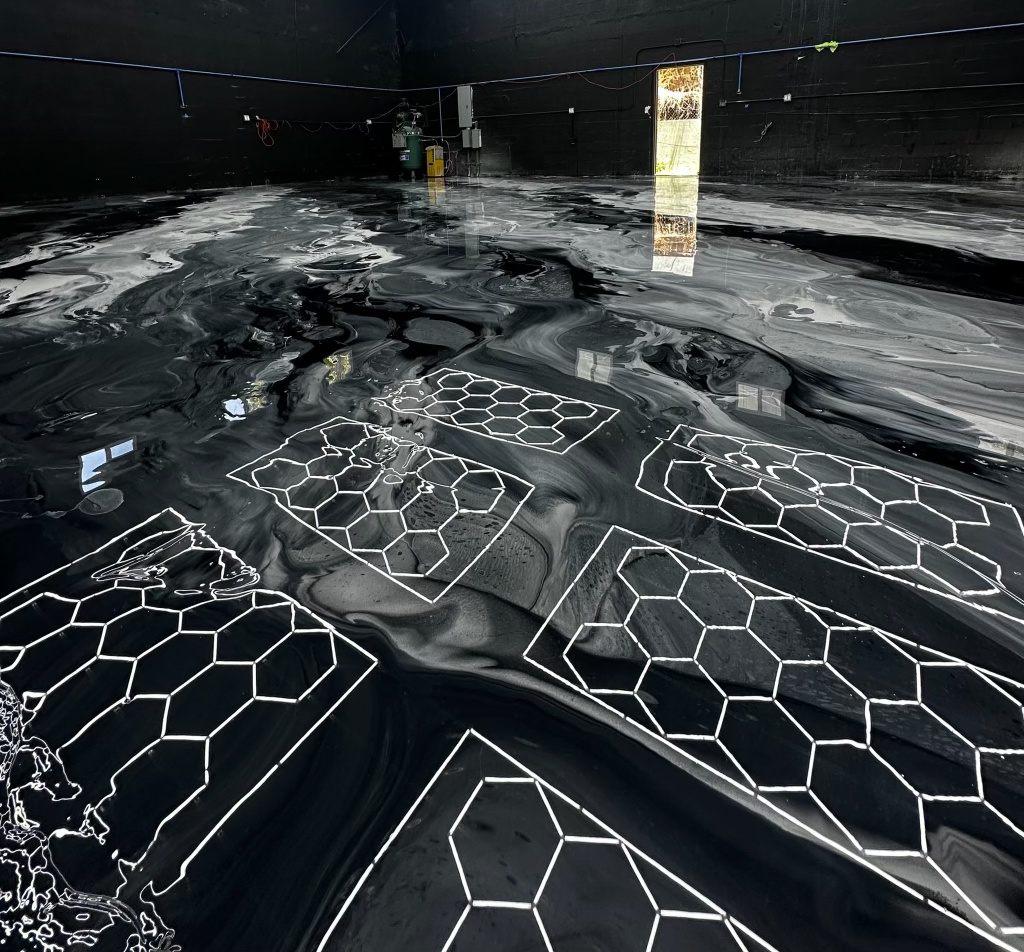
Sun through glass is the other half of the story, and it is where a quote can quietly go wrong. Standard epoxy ambers under ultraviolet light, and on a light metallic that color shift is very visible within a year. It also happens unevenly, because the part of the floor that sits in the sun path changes while the rest does not, which draws a line across the room that was never designed to be there.
Any floor of ours taking direct sun through glass gets a UV-stable polyurethane topcoat. If somebody has quoted a metallic floor for a room with a glass frontage and has not mentioned UV, that is a real gap and worth raising before signing.
Working Inside a Building That Cannot Close
Lobby and amenity pours in the beach-corridor towers have to fit around resident access, service elevators and quiet hours. That is not a scheduling inconvenience; it changes how the floor is built.
Material has to come up in a service elevator, in a booked window, in loads that fit. Resin, primer, topcoats and grinding equipment all have to be staged where they are not blocking a route residents use. And the space has to be ventilated during and after, which in an enclosed lobby means planning airflow rather than opening a roller door.
Boards and management companies want documentation, and that is reasonable. Insurance certificates, a schedule they can post for residents, and a clear statement of which entrance is unavailable and when. We are used to producing all of it and would rather have that conversation early than mid-install.
The scheduling constraint most often pushes toward pouring in sections overnight. That works, and it has one condition attached that people miss.
Break Lines Are Decided Before the Resin Opens
A sectional pour means the floor is finished in two or more passes with a cure in between. Where those passes meet, there is a cold joint: a boundary between resin that had already gelled and resin that arrived later.
On a solid color that boundary is nearly invisible. On a metallic it is not, because the pattern is a continuous flow and a cold joint interrupts it. Handled badly it reads as a mistake for the life of the floor, and since a metallic cannot be spot-repaired, the only remedy is repouring.
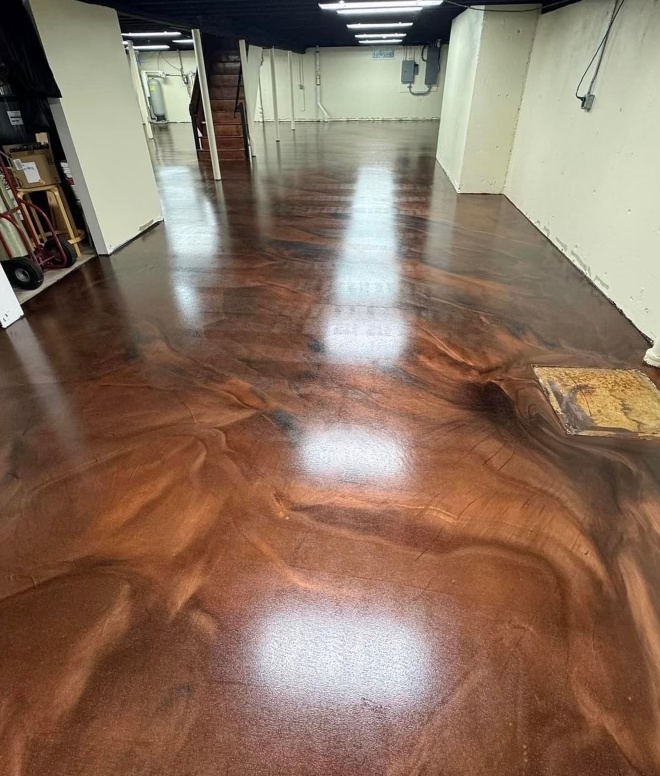
So the break line gets planned before anything is mixed, and it goes somewhere the building already has an edge: a threshold, a column line, a change of level, a transition into a different material. Placed there, the joint reads as an intentional boundary rather than a seam. Placed wherever the shift happened to end, it reads as damage.
Heat compresses the whole thing further. Resin cures on its own clock and warmth accelerates it, so pouring in an unconditioned space in August gives you minutes rather than the working time on the datasheet. We schedule these for early morning or bring temporary cooling in, because a pour that gels early takes the pattern with it.
What Owners and Boards Ask Before Committing
Can we approve a sample before the pour?
You can approve a palette and a contrast level, and we bring samples for exactly that. What no sample can show is the finished veining, because it comes out of how the resin moves on the day. Approve the character, not a pattern.
What happens if a section gets damaged later?
This is the honest trade-off. A damaged area cannot be blended back in, so the choices are re-pouring that section with a visible edge or re-pouring the room. In spaces where damage is likely, a flake system is the better specification and we will tell you so.
Can you pour over the existing tile?
Usually not directly. Tile has to come up or be ground back to a sound, level substrate, because any movement or hollow underneath telegraphs through a thin metallic layer within months. Removal means dust and disruption, and it is the difference between a floor that lasts and one that cracks along every grout line.
FAQ
Metallic Pour Questions
Can we approve a sample before the pour?
You can approve a palette and a contrast level, and we bring samples for exactly that. What no sample can show is the finished veining, because it comes out of how the resin moves on the day. Approve the character, not a pattern.
What happens if a section gets damaged later?
This is the honest trade-off. A damaged area cannot be blended back in, so the choices are re-pouring that section with a visible edge or re-pouring the room. In spaces where damage is likely, a flake system is the better specification and we will tell you so.
Can you pour over the existing tile?
Usually not directly. Tile has to come up or be ground back to a sound, level substrate, because any movement or hollow underneath telegraphs through a thin metallic layer within months. Removal means dust and disruption, and it is the difference between a floor that lasts and one that cracks along every grout line.
Bring Us the Room
Tell us the square footage, the hours you cannot lose, and whether the space takes sun through glass. We will confirm whether metallic is the right call and put a fixed number in writing. English and Español.
Get a Fixed Written Quote →Metallic epoxy in Fort Lauderdale · Gallery · (305) 409-9022