
Commercial Floors · Fort Lauderdale
The number that decides a commercial floor project is rarely the cost of the floor. It is what the business loses while the floor is unavailable. A kitchen dark for five days, a warehouse that cannot receive pallets, a showroom closed on a Saturday: those losses run past the coating quickly. Which is why almost every commercial job we install goes in around trading hours rather than instead of them, and why the phasing plan gets built before the specification is finalized.
Where the Break Lines Go
Phasing means the floor is done in pieces, with part of it usable while another part cures. Where those pieces divide is the first decision, and it is a decision about how the business runs rather than about the concrete.
In a kitchen the natural split is at the line: the cook side one night, the dish side the next. That works because the two halves have separate functions and separate traffic, so a crew can operate on one while the other is off limits. Splitting a kitchen down the middle of the cook line instead would shut the whole operation regardless of how much floor was technically available.
In a warehouse the divisions follow racking runs and drive aisles. A bay can come out of service while the aisles either side stay open, provided the route from the dock to the rest of the building is not the piece being coated. That constraint is why we walk the traffic paths before proposing a sequence, because the floor plan on paper rarely shows how material actually moves through the building.
Retail splits differently again, usually front to back or by a natural architectural boundary, and often across two consecutive nights rather than in bays at all. The common principle across all three is that a break line goes where the building already has an edge, so the finished seam reads as a transition rather than as a repair.
Fast Cure Is What Makes Overnight Possible
A standard epoxy system needs days between coats and days before traffic. That timeline is fine for an empty unit and completely unusable for a business that opens in the morning.
Fast-cure polyaspartic systems change the arithmetic. They can take foot traffic in hours rather than days, which is the entire reason an overnight turnaround exists as an option. A restaurant finishes service, the crew comes in late, and the room is ready before the first delivery arrives.
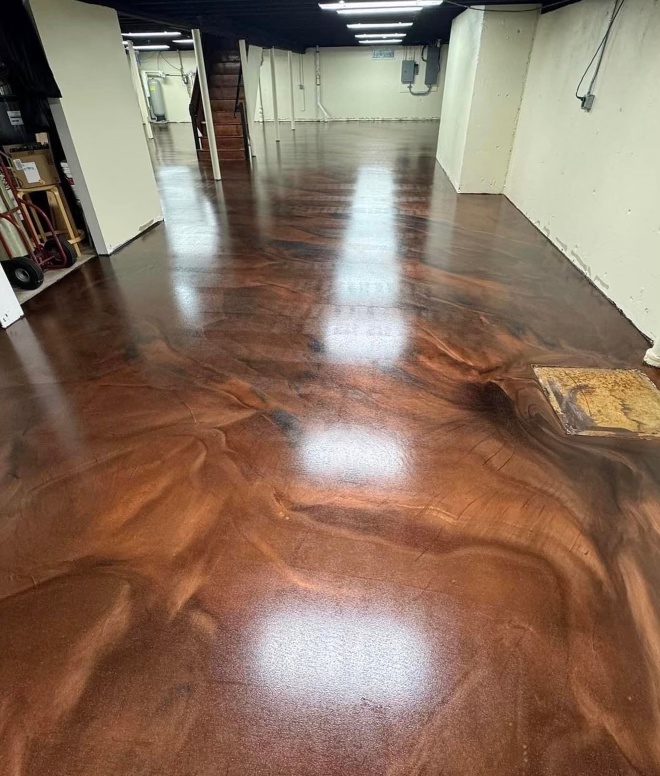
They cost more per square foot than a standard epoxy, and for a business that cannot close the difference is usually smaller than one day of lost trade. That is a calculation worth actually doing rather than assuming, because in a low-margin operation with a large floor the answer occasionally goes the other way and a weekend shutdown really is cheaper.
Odor is the other reason overnight suits this work. Modern systems are far lower odor than they used to be, but a fast-cure product still has one, and in an occupied building it needs ventilating and scheduling around. For medical spaces or anywhere with sensitive neighbors we will talk through low-odor options before booking rather than after.
Forklift Return Is Not the Same as Foot Traffic
The most common misunderstanding on a warehouse job is treating cure as a single milestone. It is not. Foot traffic, light wheeled loads and a loaded forklift are three separate thresholds, and they arrive at different times.
Foot traffic comes first, often the same shift on a fast-cure system. Light carts follow. A loaded forklift, particularly one with steel wheels, is the last, because it concentrates far more load into a much smaller contact patch and it does so while turning, which adds shear on top of pressure.
Putting a forklift on a floor that has reached foot-traffic hardness but not full cure is one of the more expensive mistakes available on a job like this. The coating deforms under the wheel, and the damage is not cosmetic; it is a permanent depression that will not level itself out as the resin finishes curing.
So the sequence gets written down: which zone comes back at which hour, for what kind of traffic. And it gets planned against your delivery schedule rather than around an assumption that a weekend is clear. A dock that receives on Saturday morning is a constraint, not a detail, and we would rather phase a job across three weekends than close a distribution floor for one.
Striping Goes Into the Floor, Not Onto It
Aisle markings, walkways, safety zones and equipment outlines are usually painted on top of a finished floor, which is why they are usually worn out. Paint on a traffic aisle takes every wheel that crosses it and it is the only thing standing between the tire and the coating.
The better approach is inlaying the lines into the system: the marking goes down between coats, so the clear topcoats run over the top of it. The line is then protected by the same material protecting the rest of the floor, and it wears at the same rate as everything around it rather than disappearing while the floor stays fine.
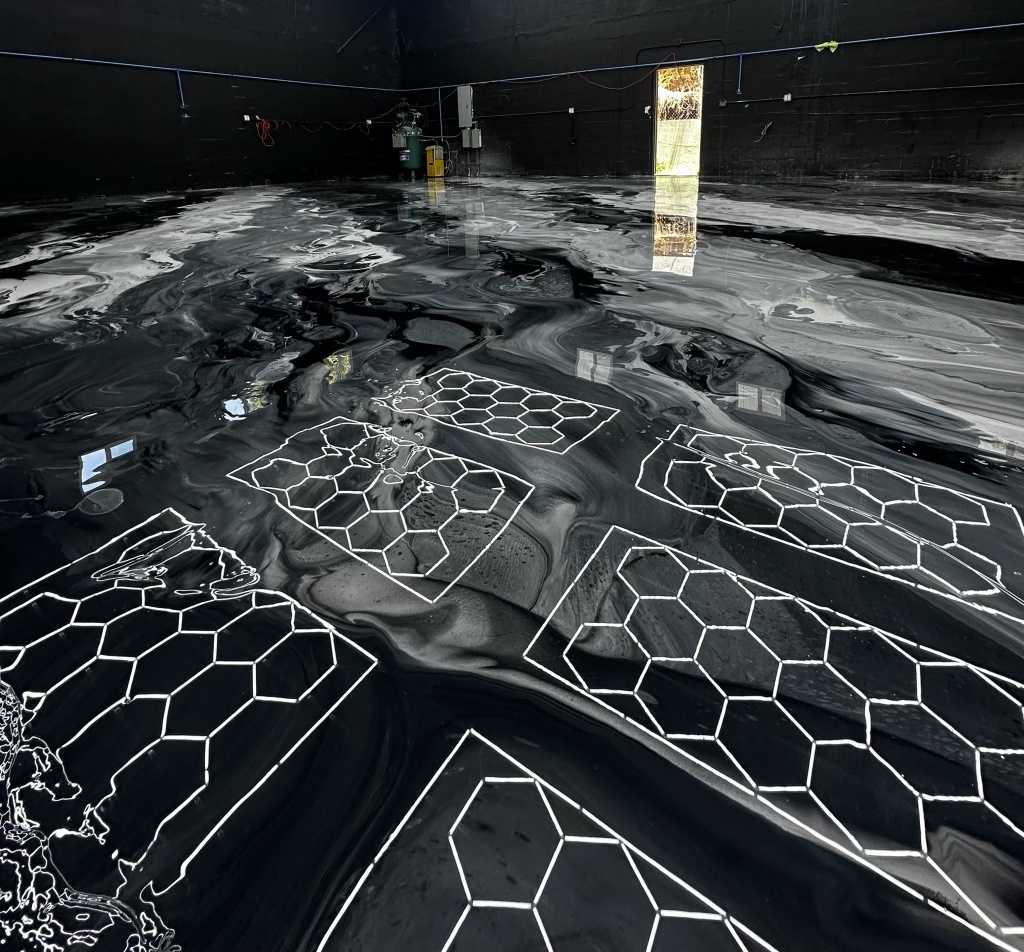
It has a phasing consequence worth knowing about. An inlaid line has to be set before the topcoats go on in that zone, so the layout has to be decided while the floor is still being built rather than after everyone has seen the finished surface. Changing a marking later means going back to bare coating in that area.
The same technique handles brand colors and logos in a retail or showroom setting. Corporate color matching is possible but takes lead time, so tell us early if it matters. Detail on systems and specifications is on the commercial epoxy page for Fort Lauderdale, and finished jobs are in the gallery.
What Operators Ask Before Booking a Phase Plan
How much of the floor is out of service at once?
Usually one zone, sized so the rest of the operation keeps running. In a kitchen that is typically one side of the line per night. In a warehouse it is a bay or a run of racking with the drive aisles either side left open. We walk the traffic routes first, because the plan has to match how material actually moves.
When can a loaded forklift go back on it?
Later than foot traffic, and it is a separate threshold rather than the same one. A loaded forklift concentrates heavy load into a small contact patch while turning, which is the hardest thing the floor will take. We give you a written return schedule by zone and by traffic type.
Can you find out what is under the current floor before quoting?
We grind or core a test patch before quoting a large space, because many older Broward commercial slabs have been coated more than once. Discovering a second failed coating halfway through a Saturday night is how a job runs into Monday trading.
FAQ
Phased Commercial Install Questions
How much of the floor is out of service at once?
Usually one zone, sized so the rest of the operation keeps running. In a kitchen that is typically one side of the line per night. In a warehouse it is a bay or a run of racking with the drive aisles either side left open. We walk the traffic routes first, because the plan has to match how material actually moves.
When can a loaded forklift go back on it?
Later than foot traffic, and it is a separate threshold rather than the same one. A loaded forklift concentrates heavy load into a small contact patch while turning, which is the hardest thing the floor will take. We give you a written return schedule by zone and by traffic type.
Can you find out what is under the current floor before quoting?
We grind or core a test patch before quoting a large space, because many older Broward commercial slabs have been coated more than once. Discovering a second failed coating halfway through a Saturday night is how a job runs into Monday trading.
Tell Us the Hours You Cannot Lose
Give us the square footage, what runs on the floor, and when the doors have to be open. We will walk the traffic routes and put the phasing and a fixed number in writing. English and Español.
Get a Fixed Written Quote →Commercial epoxy in Fort Lauderdale · Gallery · (305) 409-9022